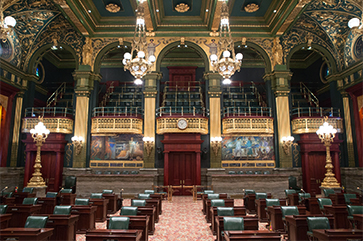
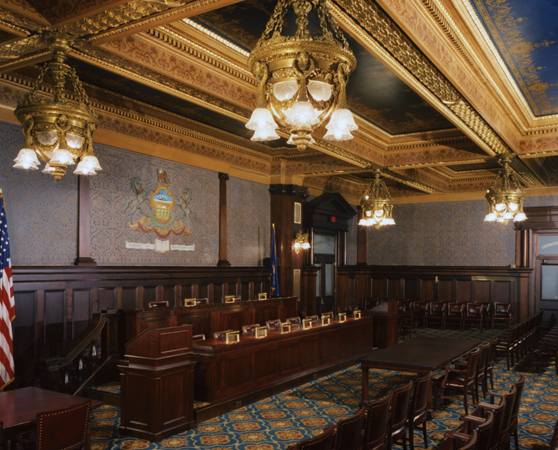
The Pennsylvania Senate was created in 1790 to serve as the "balance wheel" of the General Assembly. "The Senate will consider itself... as the balance wheel in the great machine of government, calculated and designed to retard its movements, when they shall be too rapid, and accelerate them, when they shall be too slow." — James Wilson, Principal Founder of the Pennsylvania Senate, Member of the First U.S. Supreme Court
A critical link in the checks and balance of state government, the Senate is empowered to confirm or reject key appointments of the Governor, and to serve as an equal partner to the House of Representatives in the budget process. Although the Pennsylvania Constitution stipulates that "all bills for raising revenue shall originate in the House," no appropriation, tax increase or tax reduction become law without Senate approval.
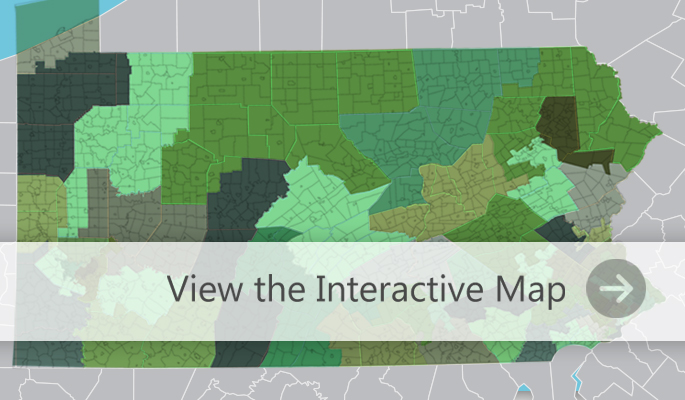
Elected for four-year terms, State Senators bring added continuity to Pennsylvania government, and — because they represent 50 districts of approximately 240,000 constitutes each — they provide a regional dimension to local and statewide priorities.

The General Assembly of Pennsylvania, like the United States Congress, is made up of two separate chambers: the Senate and the House of Representatives. Members of the Senate, representing 50 senatorial districts, primarily speak for regions of the Commonwealth, as opposed to the 203 Members of the House who represent smaller, community districts.
But for Senators and Representatives alike, the prime responsibility is making law in Pennsylvania, and only by their votes are state laws created. Their mission has remained unchanged since William Penn instructed Pennsylvania’s Colonial Assembly in 1700:
"You, Friends, are the people’s choice... You’ll see what laws are fit to be left out and what to be made, and you with me, are to prepare and propose them."
Major Duties Of A Legislator:
Propose legislation, in the form of bills and amendments, designed to meet the challenges facing Pennsylvania
Track bill status through committee caucus and both Chambers
Maintain an open dialogue with district residents, government officials, and civic leaders to identify critical needs; and work to find solutions
Participate in Floor sessions and vote on all bills presented for consideration
Shape a balanced annual state budget
Through committee hearings and investigations, assure that public money is well spent and services properly performed
Update constituents on the progress of legislative bills, state services and programs, and handle constituent requests and questions


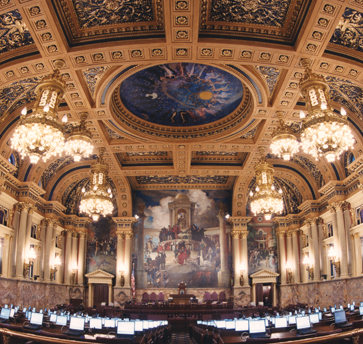
The House of Representatives is the largest and oldest statewide organization in Pennsylvania, the oldest continuous democratically elected body in the United States. Convened by William Penn in 1682 as the first Colonial Assembly, it charted the course of democracy in America.
In the 1700s, the House established the first independent Supreme Court; convened meetings to create the Declaration of Independence and the U.S. Constitution; founded the Pennsylvania Senate; and formed an executive branch of state government.
That proud tradition is continued today by the 203 men and women elected to the House of Representatives every two years. Each one represents approximately 59,000 Pennsylvanians, and serves as their collective voice in Pennsylvania government.
Known as the "workshops of the General Assembly, committees play a critical role in screening, studying, and debating up to 5,000 bills that are proposed in a single term. And, in fact, according the Pennsylvania Constitution, no bill can be considered unless it has first spent time in committee.
On average, Pennsylvania Senators serve on six permanent standing committees, which can change or amend a bill; defeat it; send it on to the Senate Floor for a vote; or table — or set it aside — to make it inactive.


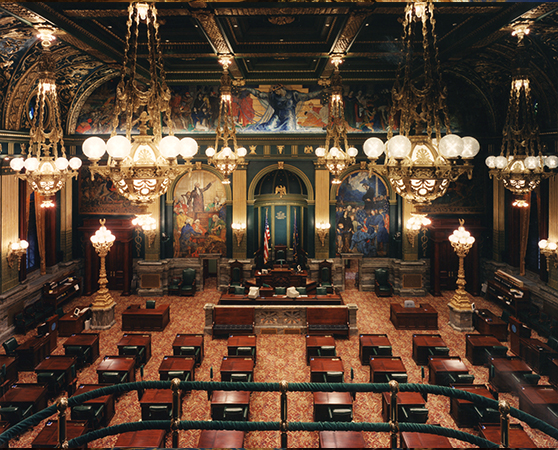
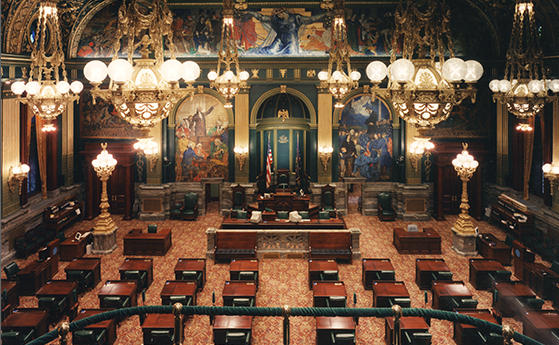
The seating arrangement is rectangular in shape, with ten rows of five member desks facing the President's rostrum which is set precisely in the center of the Floor, on the highest tier. If the President is presiding, the President Pro Tempore sits next to the Floor Leader of his or her party — Democrats on the left, and Republicans on the right. Senate employees and other officials are grouped on or around the President's rostrum. They're easily identified by their location, as show in this diagram. Touch to explore each position on the Senate Floor.


The Pennsylvania Constitution provides that the Lieutenant Governor also serves as the President of the Senate. In this capacity, he or she presides over all Senate sessions, and may cast a vote in the case of a tie. If, however, a tie vote has been reached on the final passage of legislation, the Lieutenant Governor's vote cannot be used as a tie-breaker.

Elected bi-annually by the Members of the Senate, the President Pro Tempore is the Senate's highest ranking member/officer, and presides over each session in the absence of the Lieutenant Governor. The third ranking constitutional office in the Commonwealth, the President Pro Tempore succeeds to the offices of Lieutenant Governor and Governor in the event of the death or disability of those officers.

The Secretary/Parliamentarian is elected by the Members of the Senate for a two-year term. A non-member officer — and always an attorney – the Secretary/Parliamentarian offers advice on all procedural and legal matters that arise.

Elected by the Members of the Senate for a two-year term, the Chief Clerk is a non-member officer — and chief fiscal officer — of the Senate. The Chief Clerk is responsible for the day-to-day financial functions of the Senate, and also serves as the Secretary to the Committee on Management Operations.

These aides are appointed to assist the Secretary/Parliamentarian in processing all bills, amendments, messages or nominations from the Governor or House of Representatives, motions, resolutions and any other business the Senate may consider.

Because the Pennsylvania Constitution requires the Senate to publish a verbatim Journal of its proceedings, the Chief Official Reporter and staff transcribe all debate and action taken on the Floor.

Sometimes referred to as the Republican or Democratic Leaders, these official Floor Leaders are elected by their respective caucuses. They are responsible for leading debate, and for implementing their party's strategy on the Senate Floor.

The Whips serve as the Assistant Floor Leaders and act as links between their party caucus members and the Leaders. They keep the members of their caucus informed of all positions and encourage votes along party lines. The Minority Whip traditionally sits at the desk directly to the inside of the Floor Leader's desk.

Young men and women deliver messages, distribute necessary paperwork, and run errands for the Members of the Senate when it is in session.

Various journalists from newspapers and wire services are accredited to sit on the Senate Floor during session. Seats for these reporters are reserved at the rear of the Senate Chamber.

There are fifty Members of the Pennsylvania Senate, each serving a four-year term, and each representing approximately 240,000 Pennsylvanians.

Because up to 5,000 bills can be proposed in a single term, a variety of permanent committees have been formed to manage the workload related to screening, studying, debating, and resolving differences over bills.
On average, Pennsylvania Representatives serve three standing committees which can table, or set aside, a bill; change or amend it; defeat it; or send it to the Floor for a vote.


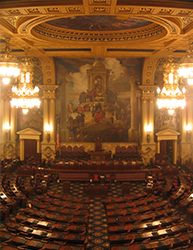
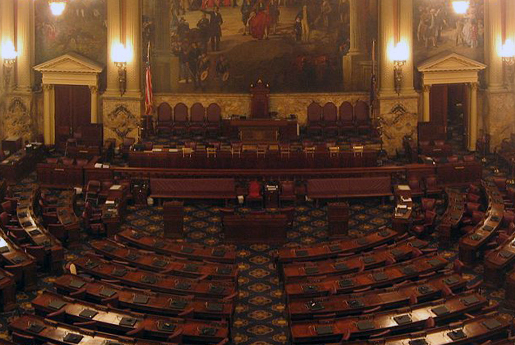
In a seating arrangement adopted from the French National Assembly, the House is divided by a center aisle with Democrats on the left and Republicans on the right. The Speaker's rostrum is precisely set in the center on the highest tier, and all legislators face that way.
But not everyone on the Floor is a legislator. House employees and members of the press are there too. They're easily identified by their location, as show in the diagram.


Elected by all members of the House, the Speaker is the presiding officer, conducting each session, voting on every bill, referring all bills to committee, and appointing all committee chairmen. It is the oldest statewide office in Pennsylvania and the only office in the House mandated by the Pennsylvania Constitution.

An attorney who stands at the Speaker’s side, the Parliamentarian provides expert advice on rules of order and any legal issues that may arise.

Carrying the mace – a symbol of authority – this official precedes the Speaker to the rostrum before each session, and after adjournment, ceremoniously escorts the Speaker from the Chamber.

This House-elected official is responsible for the day-to-day operation of the House, supervises the printing of all House bills and journals, and convenes the House to elect the Speaker on the first day of every new session.

These aides are appointed to assist the Chief Clerk in tracking bills and amendments, messages from the Senate, motions, resolutions, and any other business the House considers.

These stenographers are employed by the Chief Clerk to transcribe the official remarks made on the Floor and to enter them into the House Journal.

Elected by their respective parties, these are the official Floor Leaders, responsible for developing party strategy, maintaining unity, leading Floor debate, and gaining passge of legislation approved by their party members.

These are the Assistant Floor Leaders who serve as links between their respective party members and Majority and Minority Leaders. The term "Whip" was borrowed from the English Parliament and is a fox hunting term for the rider who did not permit the hounds to stray.

Each party employs its own group of pages to deliver messages, distribute paperwork and the like to the Members of the House when it is in session.

On any given day, various journalists may be present at House sessions. A block of seats is reserved for representatives of specific wire services and newspapers.

There are 203 Members of the House of Representatives, each serving a two-year term, and each representing approximately 59,000 Pennsylvanians.
![]()
![]()